Hit Point Press
Kaaltar
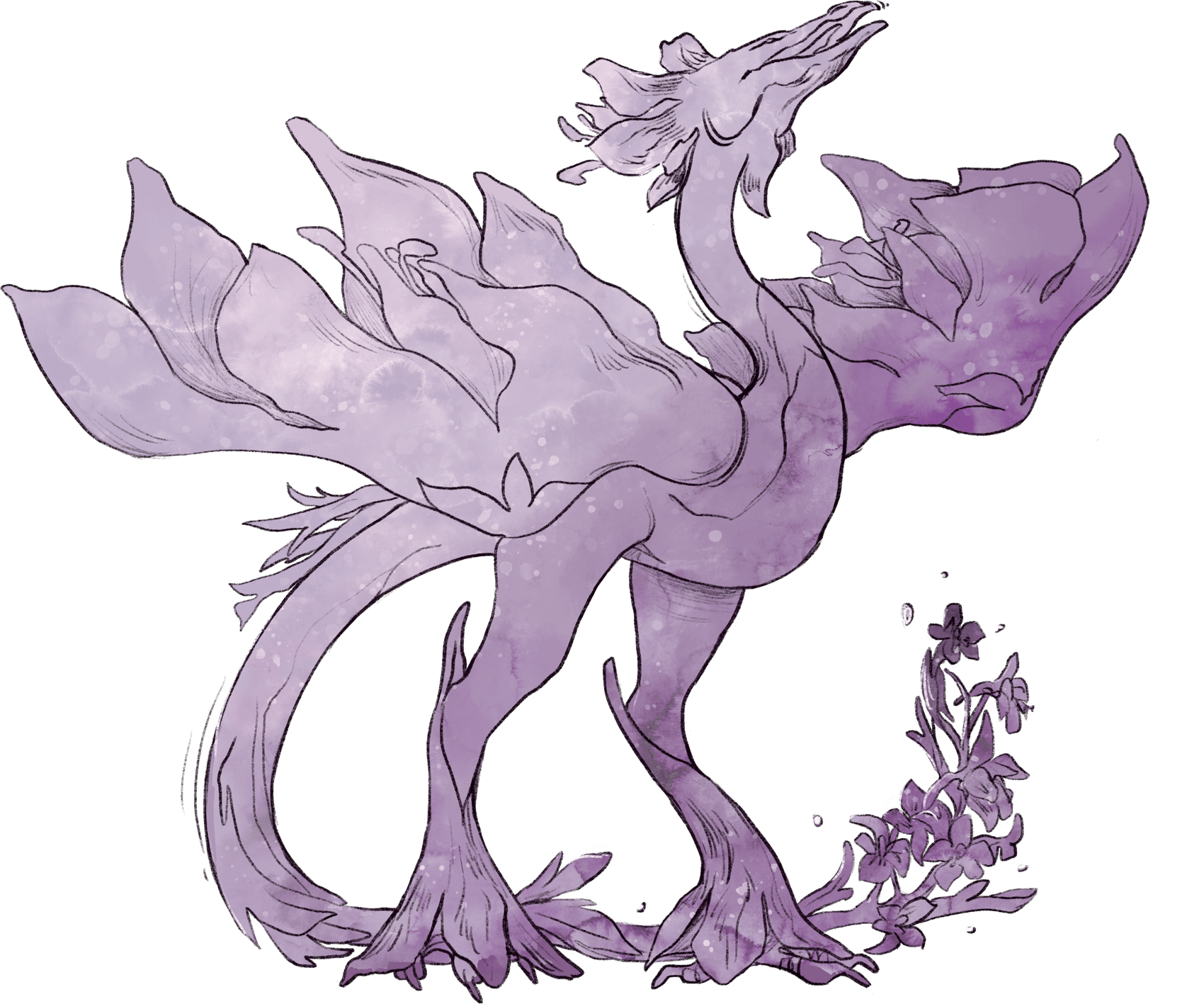
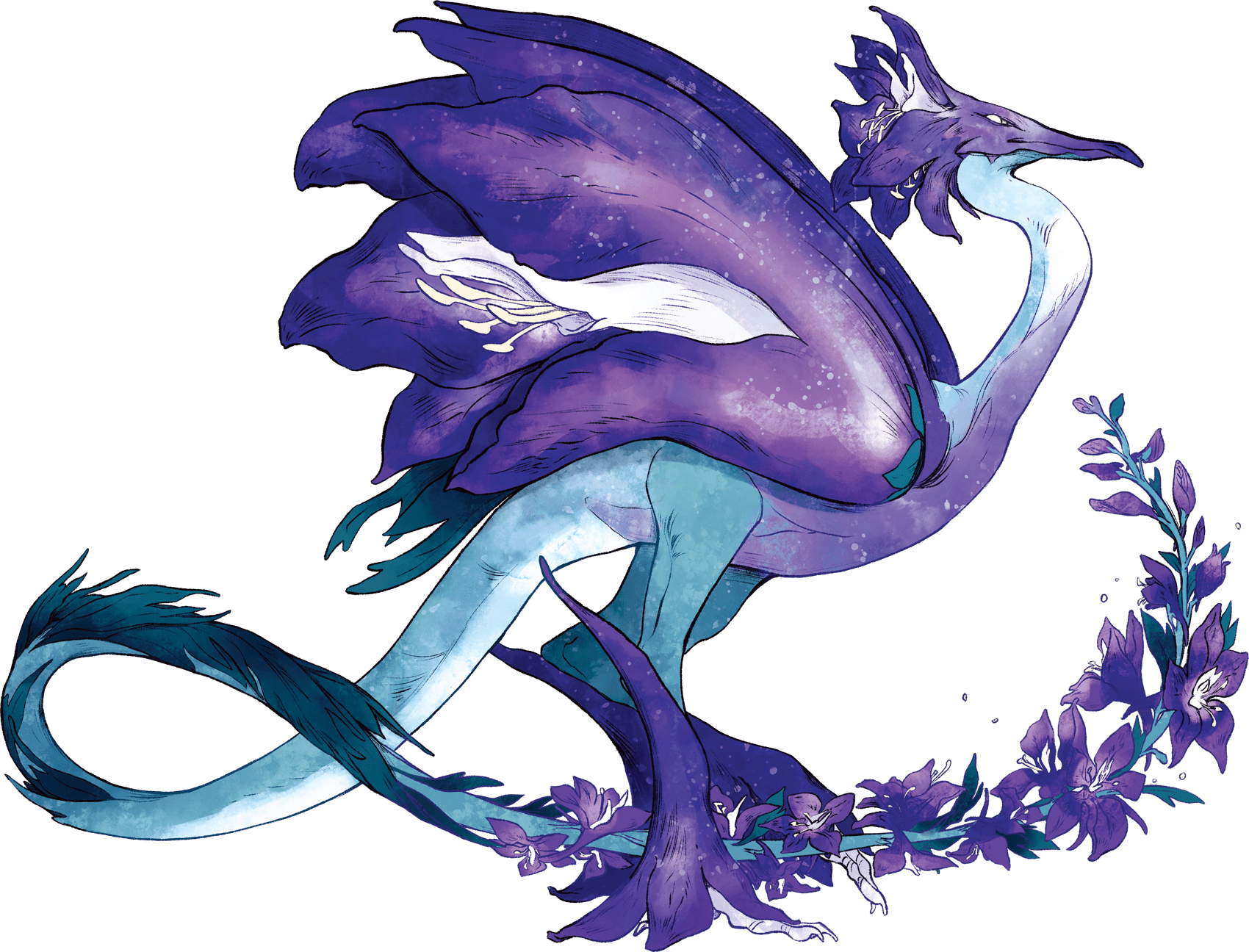
A larkspur dragon’s petals may seem inviting, but they are coated with a deadly toxin.
The Dragon from the Sea
The larkspur dragon wasn’t always a floral dragon. Legends say it was once an eel, sought after by mages who required its fins as a spell component. These powerful magic users hunted the eels to the brink of extinction, so a god of the sea made a deal with a god of the forest to transform the eels into land creatures for their protection. The god of the forest gave the eel long, fast legs to run from predators, a sharp beak to fend off enemies, and beautiful yet poisonous flowers to kill anyone who dared try to hunt it again.
However, the transformation replaced the larkspur’s fearful temperament with a dragon’s haughtiness and aggression. Some believe these descendants of eels carry memories of cruel treatment at the hands of humanoids, and their resentment manifests in the larkspur dragon’s obnoxious nature.
Kaaltar
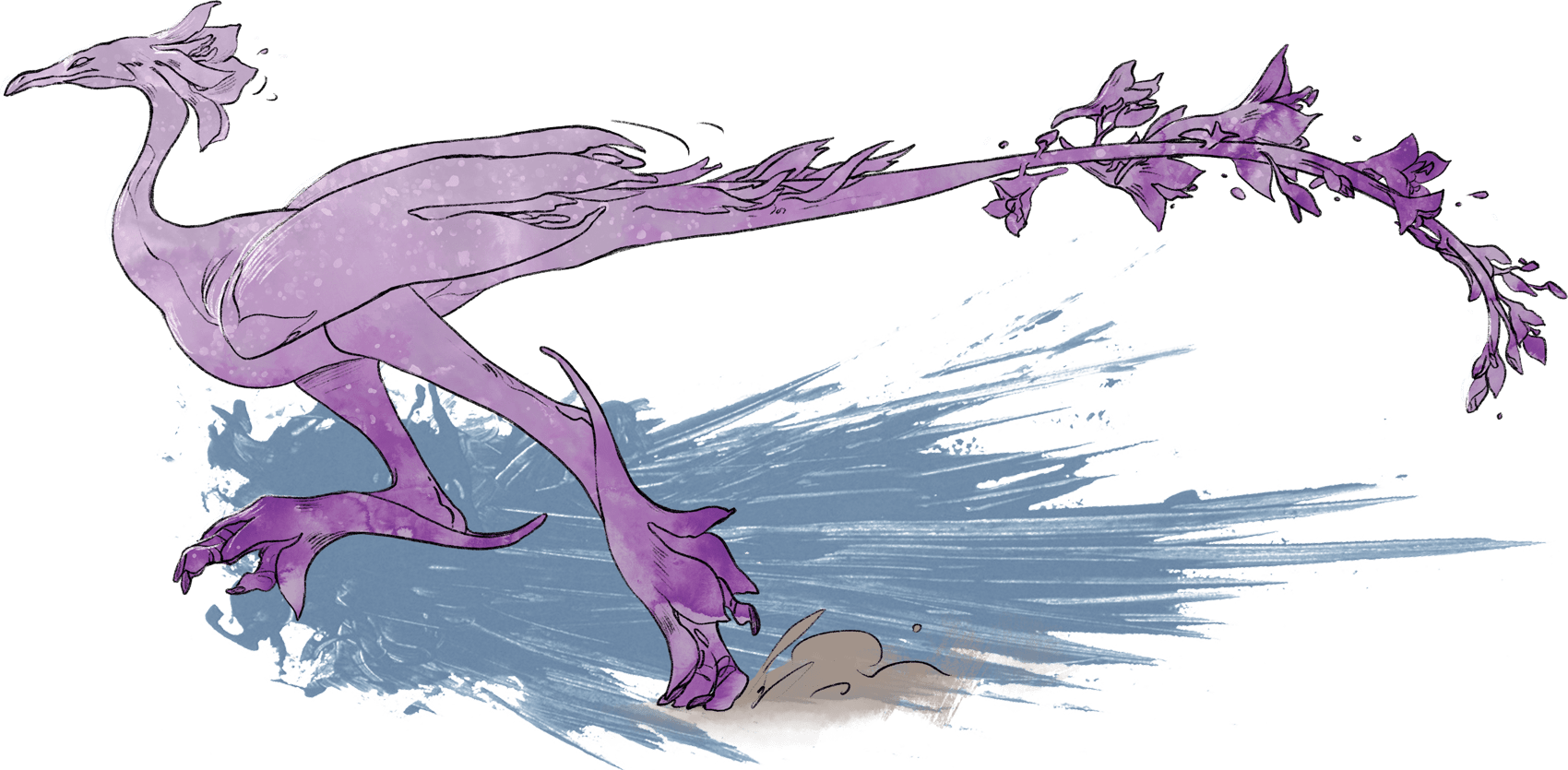
Legends say larkspur dragons were once eels, but you’d never guess it seeing one run. They move with graceful strides at speeds too fast for predators to catch them.
A common misconception is that larkspur dragons must be flightless, but they do indeed fly. This taxes them more than their elegant overland movement. Still, how remarkable is it that a creature born from the sea could adapt so spectacularly to both land and sky?
Physiology
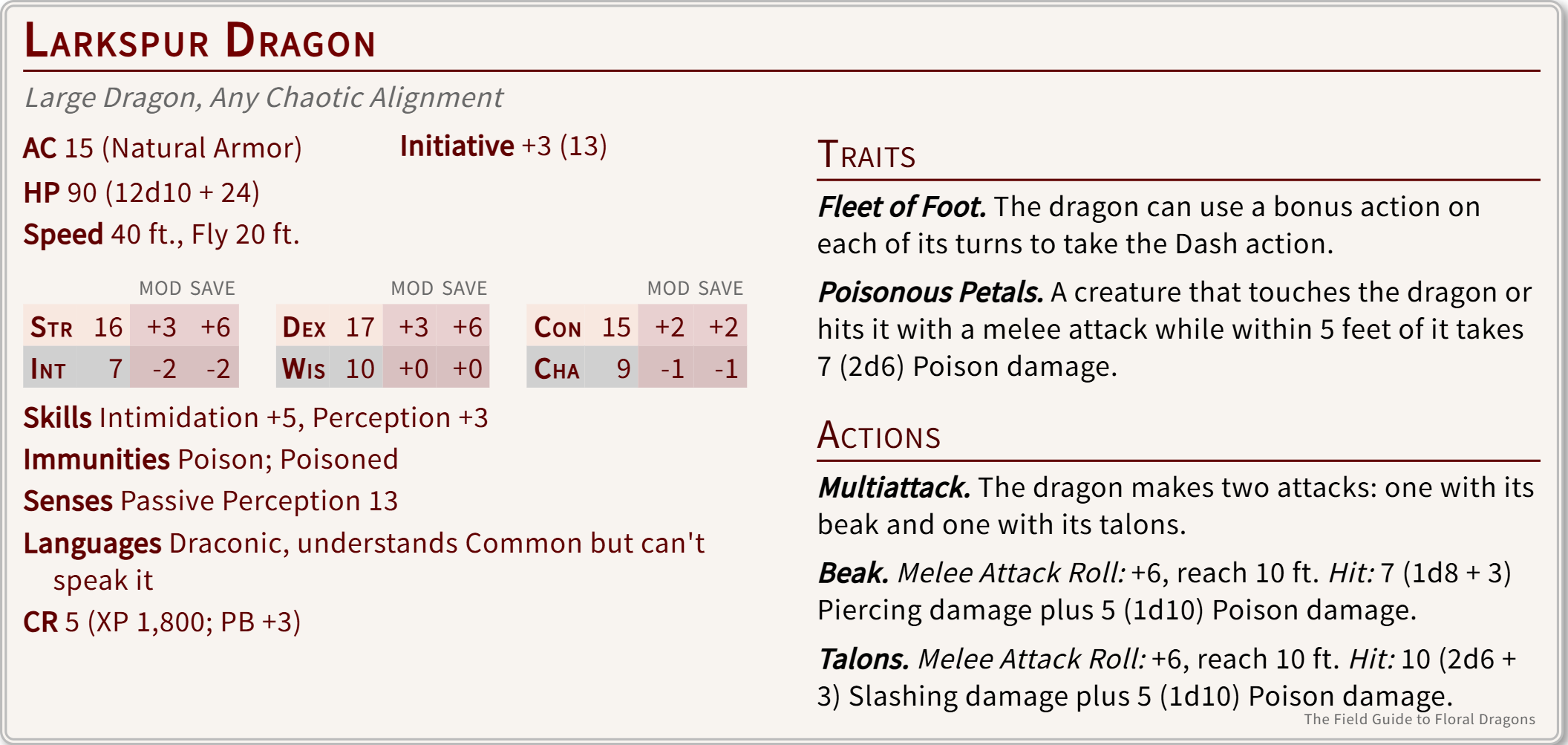
Despite their deceptively delicate features, larkspur dragons have strong natural defenses. They mature at 50 and can live to around 400 years old. Larkspur dragons can eventually grow be up to 20 feet in length and 10 feet tall, weighing about 200 pounds. Their petals are thin and come in deep shades of indigo, purple, and pink. They can fly short distances but are most comfortable on the ground. They are bipedal, with large claws for traction, and lithe, agile bodies built for running long distances at great speeds. Thanks to their long necks and sharp beaks, larkspur dragons can attack enemies from outside their range of retaliation. Instead of flight, larkspurs more frequently splay their wing-petals to make themselves look larger and more intimidating.
All larkspur dragons are poisonous, and their petals are toxic to the touch. The petals conceal a potent threat: the seeds nestled within contain the highest concentration of poison on any part of the dragon’s body. Creatures that consume the seeds die within hours of eating them.
Caption
Fig. 1 A larkspur dragon running.
Habitat
Larkspur dragons prefer environments with full sun, well-drained soil, and frequent rain. Though these are also ideal conditions for many species of floral dragons, the larkspur is so hostile that most others will flee rather than try to fight one for territory.
Always on the move, loose bloomings of larkspur dragons migrate year-round. As long as there is enough food for the blooming, they’ll stay in one place. They behave as though they own any place they arrive in, and they view other inhabitants of the area as intruders, even when the opposite is true. When the dragons have depleted an area of food, they move on.
Perhaps due to their marine origins, larkspur dragons do not tolerate drought or dryness. They avoid forests with thick canopies that cast deep shade, preferring open meadows, steppes, prairies, and grasslands.
Behavior
As omnivorous creatures, larkspur dragons hunt small mammals, birds, and the much smaller dandelion dragons. Their long necks also allow them to eat leaves and fruit from tall trees.
Larkspur dragons change mates yearly and produce five to eight eggs each breeding season. They are unaffectionate parents and expect their offspring to keep up with the roaming blooming within days of hatching. Young larkspur dragons are docile and friendly until they mature, at which point they become vicious and possessive over the land they view as their territory.
Although highly aggressive to other creatures, larkspur dragons are social among their own kind. Even so, fights between them happen regularly, often over perceived slights.
Larkspur dragons are highly combative when they feel threatened by almost anything that intrudes on their territory. If disturbed, a larkspur dragon won’t hesitate to attack first. They fight to injure in the hope their opponent retreats in defeat, but they won’t hesitate to kill a creature that continues to attack them. A larkspur dragon will chase other creatures from its territory, but if the threat moves far enough away, the dragon is content to return home. A larkspur dragon will only flee if it is certain it cannot win. While larkspur dragons are generally cantankerous, their primary adversaries are peony dragons, one of the few creatures that can withstand the larkspur dragon’s toxins.
Among floral dragons, only the heliconia dragon has truly befriended the larkspur. They share a love of music and weave their songs together into breathtaking harmonies. Larkspurs can also be found acting uncharacteristically peacefully around magnolia dragons and eating the fruit that they scatter. It is theorized that the larkspurs respect the powerful magnolia dragon’s prohibition of violence among the creatures that gather around it.
If a larkspur dragon encounters humanoids within a few days of hatching, it can be raised in captivity. With care, some humanoids have succeeded in raising larkspur dragons and trained them as mounts. Their speed and offensive prowess make them ideal mounts, and their natural belligerence can be tamed, making them loyal and protective companions. Larkspur riders must wear protective gear to protect them from their mounts’ toxins.
Kaaltar
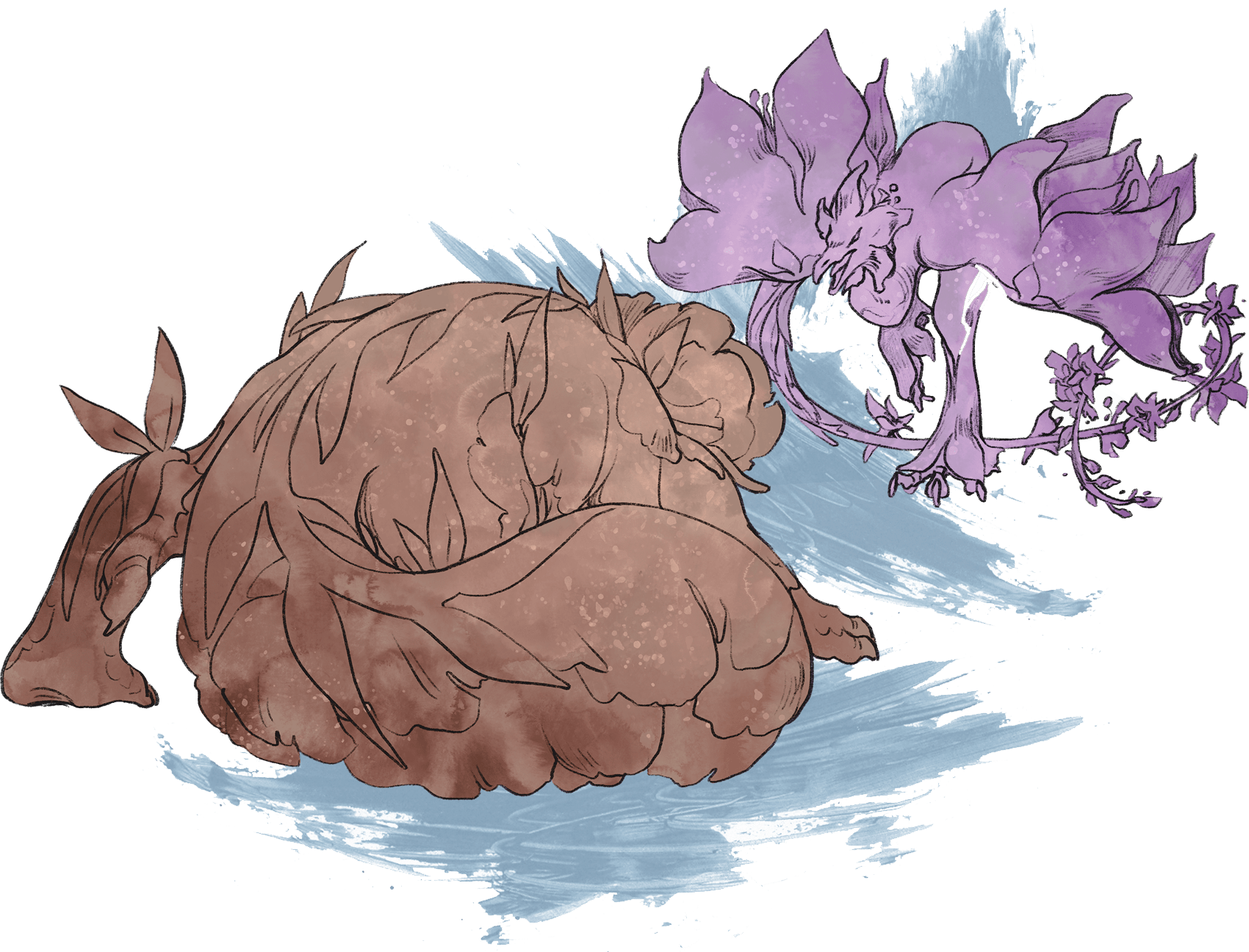
The peony dragon is a natural predator of the larkspur. Though the peony dragon is resistant to the larkspur’s toxins, it relies on surprising its prey to land a kill. I once witnessed a standoff after a peony’s ambush failed.
The two appeared evenly matched, and the larkspur dragon flared its wings wide to intimidate its foe. The peony was driven off by the larkspur’s extreme pugnacity.
Caption
Fig. 2 A larkspur dragon faces off against a peony dragon.
Personality Traits
Larkspur Dragon Personality Traits
| d8 | Trait |
|---|---|
| 1 | If I sense a sudden movement, I charge at its source without thinking. |
| 2 | I whip my tail around when I am impatient or angered. |
| 3 | I never bow my head or lower my neck. Everyone else must look up at me. |
| 4 | I underestimate other floral dragons, and I am defeated in combat more often than I would like. |
| 5 | Anytime I see another creature or vehicle moving very fast, I try to race it, even if I don’t know where it is going. |
| 6 | I can’t stand company. Nothing infuriates me more than other creatures in my space. |
| 7 | I walk around with my wing-petals raised at all times. |
| 8 | I enjoy tricking humanoids into touching my petals. It amuses me when they foolishly poison themselves. |
Motivations
Larkspur Dragon Motivations
| d6 | Motivation |
|---|---|
| 1 | I won’t stop until I have claimed this entire forest as my own. |
| 2 | I was raised by humanoids, but I am curious about a blooming of wild larkspurs that recently arrived. I want to meet them. |
| 3 | I’m interested in finding ways to enhance the toxicity of my petals. |
| 4 | I want to be the fastest floral dragon that ever existed. |
| 5 | I hunt mages. They are responsible for my ancestors being driven from the sea long ago. |
| 6 | My dream is to fly long distances, no matter difficult it may be. |
Adventure Hooks
Here are ways to include larkspur dragons in your game.
| d4 | Adventure Hook |
|---|---|
| 1 | One of the larkspur dragons a village keeps as a mount has run off into the forest. The residents are concerned for its safety. |
| 2 | A larkspur dragon has taken up residence in a forest for an unusually long time. Its poisonous seeds threaten the plants a nearby settlement relies on for medicine. |
| 3 | A larkspur dragon has found a small humanoid settlement deep within the forest and is trying to claim the area as its own, attacking everyone who lives there. |
| 4 | Two rival bloomings of larkspur dragons reached the same territory at the same time and are fighting over it, risking its total destruction. |
Kaaltar
One night, by a stroke of luck, I stumbled upon a larkspur dragon singing a clear and melodic warble that echoed through the trees. Was it trying to attract a mate or simply singing for pleasure?
All the same, I’m thankful the larkspur shared its song with me. Perhaps you will be so lucky one day as well.
Caption
Fig. 3 A larkspur dragon mid-song.