Hit Point Press
Izora
Clematis dragons are highly poisonous and easily provoked.
The Creation and Break Out of the Clematis Dragon
The clematis dragon is one of the most recent floral dragons to come into being, with a genesis sometime within the last century. While the origins of most floral dragons are shrouded in myth, the origin of the clematis dragon is well documented and illustrates that floral dragons can be intentionally created.
The first clematis dragon was created by Jeor Fandor, a young court wizard who used transmutation magic to combine draconic blood with floral essence. His goal was to create a unique and aesthetically pleasing creature for the prince’s garden. While his first attempts ended in failure, Jeor figured out that the missing ingredient was frog extract. The extract allowed him to stabilize the mixture and produce the first clematis dragons.
According to rumor, Jeor created the dragon to catch the eye of Prince Lucian. Given that Jeor and the Prince were wed the following autumn, there is evidence that Jeor’s efforts were successful.
Jeor’s original notes show that he intended to create a dragon that was docile, beautiful, and hardy. The young wizard’s notes also detail the creature’s remarkable ability to absorb toxins from its environment and hold them inside its body without suffering any ill effects.
Within a few generations, however, Jeor’s creations began to manifest their draconic heritage. Each spawning was more irritable and unruly than the last. Jeor tried to cull the population, but it was too late. Overconfident of the creatures’ docile nature he had underestimated the need to fence them inside the garden. Soon, naturalists began to report sightings of clematis dragons in the wild.
In the decades since, these dragons have spread far and wide, disrupting local ecosystems and even invading some cities where they have become dangerous pests.
Physiology
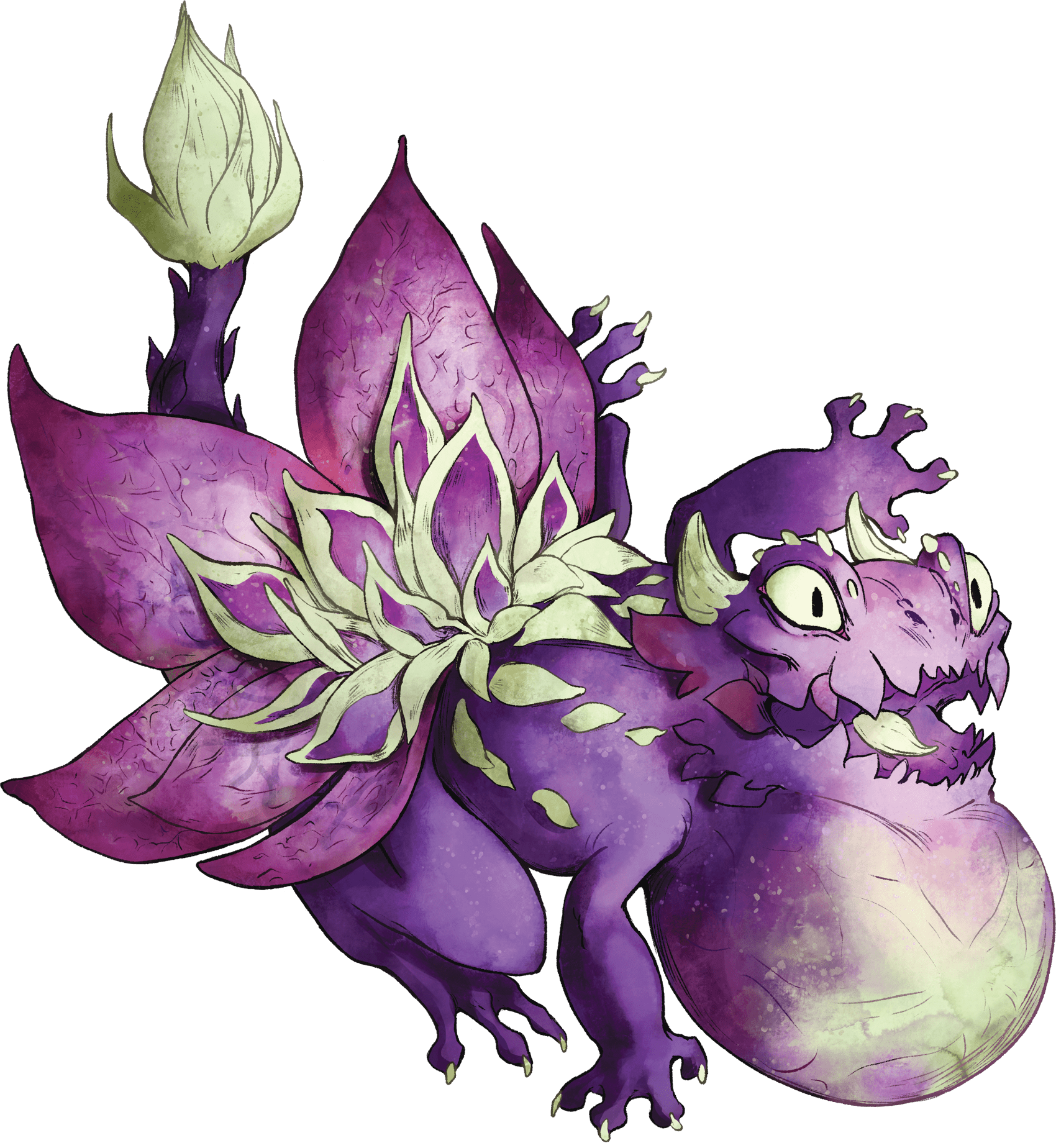
The clematis dragon is small and frog-like with a squat, round purple body. Adult clematis dragons are about 1 foot long from head to tail and stand only 4 inches tall at the shoulder. They are short-lived, reaching 5 years of age at most, but mature and breed rapidly. Though they need water to reproduce, their adult forms are mostly terrestrial and arboreal. They are excellent climbers, decent swimmers, and can jump two body lengths without much effort.
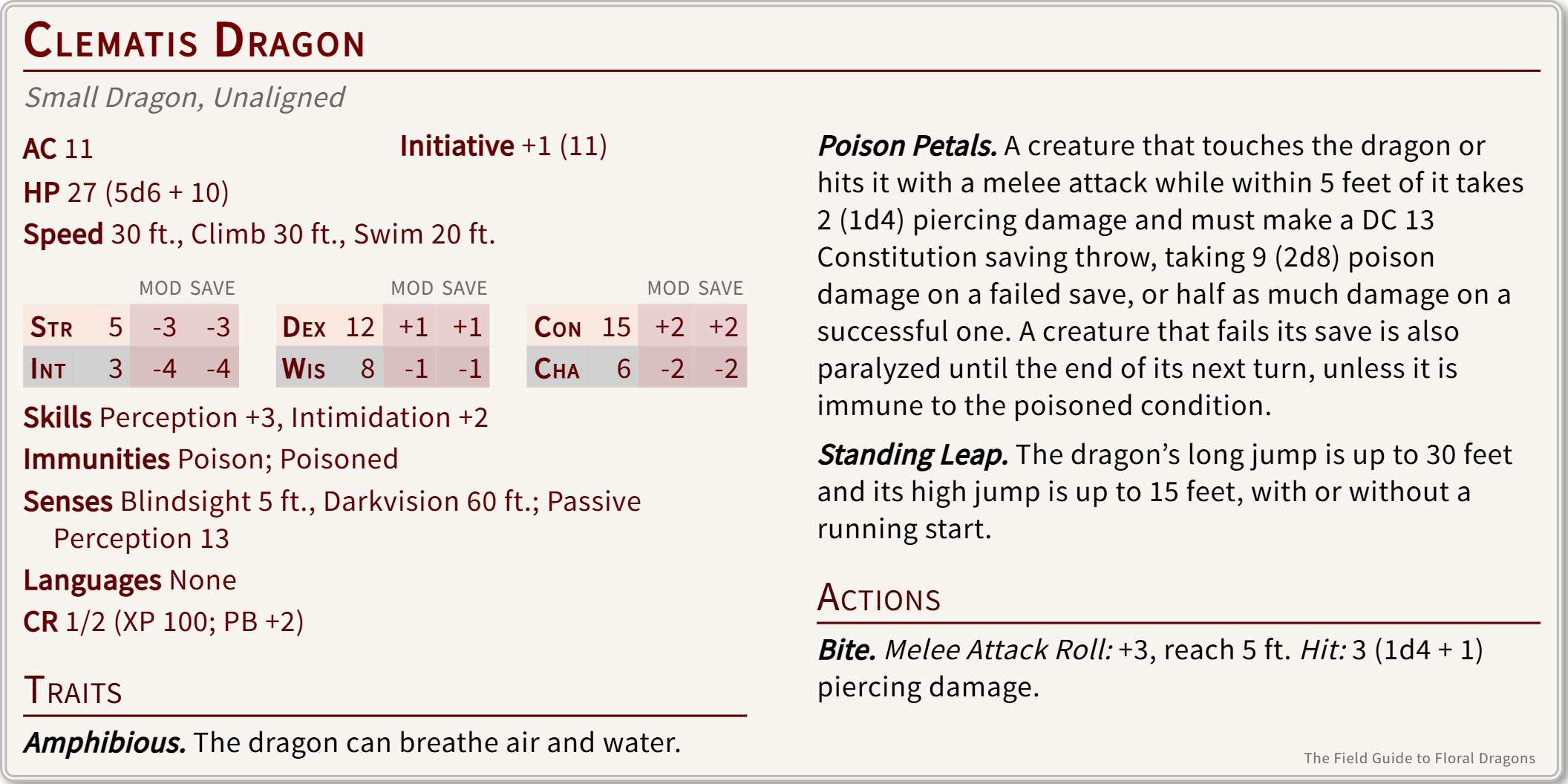
Adult clematis dragons store toxins in a special gland located within their throats. This gland can burst if the body is punctured, making the dragon poisonous to predators that attempt to eat it. The toxin gland can be harvested for use by alchemists and assassins, who have learned how to distill clematis dragon’s poison into a potent sedative that can cause a complete lack of bodily sensation when it circulates through the bloodstream. Clematis dragons lick themselves all over to coat their petals in a powerful defensive toxin.
Caption
Fig. 1 A clematis dragon’s relaxed
and defensive postures.
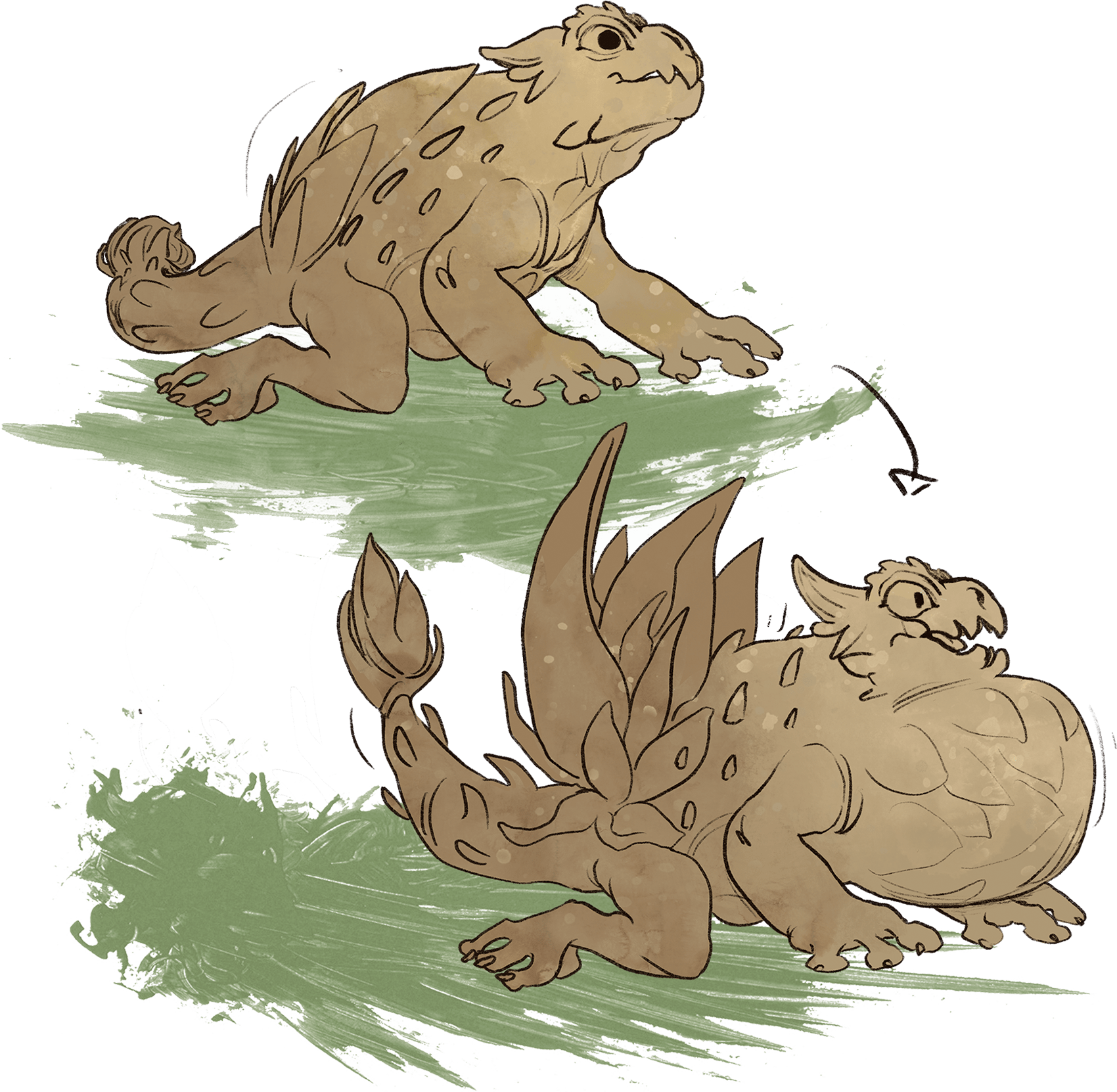
The dragon’s back sports long petals that range from warm violet to iridescent blue-purple with cream-colored to light green edges. When calm, a dragon keeps its petals flat, but if agitated, they flare them to threaten predators. The razor-sharp petals that cover the adult dragon’s body serve as a delivery system for the toxin it licks onto itself. Clematis dragon poison is potent and can cause paralysis and even death in many mammals and humanoids. A flower bulb on the tip of its tail blooms only when it is ready to mate. The clematis dragon’s teeth are also modified petals, similar in color, shape, and sharpness, though they aren’t coated with toxin. These teeth allow the dragons to eat a variety of things, from plants, nuts, and bark to insects and small animals. Their sharp teeth and extraordinary constitution allow them to digest things that other creatures find inedible, making these small dragons incredibly adaptable.
A Potent Poison
Clematis poison can be harvested from an adult clematis dragon’s poison gland. It is prized by assassins because it completely immobilizes the victim. The gland containing the poison must be harvested from a dead or incapacitated clematis dragon.
Habitat
Thanks to the essence of frog used in their creation, clematis dragons prefer to live close to marshes or large bodies of water.
They live high in trees or in tall stands of reeds or similar vegetation and keep their shelter damp by lining them with carpets of moss. Like most floral dragons, clematis dragons dislike the cold. They spend the winter months hibernating in mud at the bottom of lake beds, emerging in spring.
Though adult clematis dragons are too toxic for most creatures to consume, they are easy prey for creatures that can tolerate their poison. Vampire lily dragons and aconite dragons are immune to their toxins and clematis dragons are an abundant food source for these predators.
Large numbers of clematis dragons can be detrimental to their habitat. They breed quickly and can overtake an environment if not kept in check by predators. However, a small population of clematis dragons can be a sign of a healthy marsh: the dragons passively absorb toxins from soil, water, and trees through their porous skin, gradually transforming polluted swamps into fertile wetlands. There have been reports that non-poisonous clematis dragons can be found in pristine wetlands, though these subspecies are far more elusive than their toxic cousins, as they rely on camouflage for defense.
Recently, clematis dragons have become a common sight in cities located on rivers or lakes, where they are recognized as a new kind of pest. There, they nest in sewers or roost on the tall spires of buildings, and feast on city birds, rats, and food waste, all of which they can safely consume. When populations of urban clematis dragons grow large, they can pose a real threat to the people living there, as they are difficult to remove and are easily provoked.
Izora
When I heard stories of a poisonous floral dragon created with magic, I simply had to find it. This clematis was calm until I contained it; when it realized it was my captive, it puffed up its throat.
It is a fine specimen and will be perfect for my experiments. Perhaps I can use the dragon’s poison to make my mushrooms even deadlier to other floral dragons. I’ll run some tests to confirm.
Behavior
Generally, clematis dragons are known for their intractable nature and bad tempers. They have little fear of creatures larger than themselves and possess limited intellect, being entirely unable to comprehend spoken language. These overconfident dragons are thwarted by even simple traps.
Misplaced bravery and few wits means these dragons will stand defiant against even the most immense foes, and they act as though they belong wherever they go. Despite being easy to hunt and catch, clematis dragons have thrived because of their poisonous bodies and their rapid rate of reproduction.
Clematis dragons reach sexual maturity as soon as they become adults. Clematis eggs resemble frogs’ eggs and must be laid in water, where they hatch into tadpole-like wyrmlings. Clematis wyrmlings aren’t poisonous, making them easy prey for fish and water birds. This is why female clematis dragons lay large clutches, from which only a few hundred wyrmlings survive. The entire population mates around the same time in late spring, flooding waterways with so many spawn that predators can’t catch them all.
After two months, clematis wyrmlings change into juvenile dragons that more closely resemble their adult forms. Juveniles grow lungs and can leave the water, but they still require lots of moisture to thrive and grow.
Juvenile clematis dragons lack the poisonous defenses of adult clematis dragons until they have absorbed sufficient toxins. Their bodies are still slightly toxic, however, making them unpleasant to eat. After two months, juveniles bloom into their full adult forms.
Izora
Though clematis dragons prefer to make their homes up high, they line their shelter with moist mosses to keep their skin hydrated.
I’ll recreate this environment for my captive clematis dragon, but I’ll also see how it fares in other conditions. It will be fascinating to observe how the dragon’s habitat affects its poison.
Personality Traits
Clematis Dragon Personality Traits
| d8 | Trait |
|---|---|
| 1 | I like to cause mischief. |
| 2 | I am always hungry and beg loudly for scraps. |
| 3 | I fear nothing. |
| 4 | Lazing on a lilypad is my idea of heaven. |
| 5 | My territory is mine alone, and I defend it against all trespassers. |
| 6 | Once I’ve decided I like someone, I’ll never leave them alone. |
| 7 | I will eat, or try to eat, anything I can fit my jaws around. |
| 8 | I am easily agitated and quick to bite. |
Motivations
Clematis Dragon Motivations
| d6 | Motivation |
|---|---|
| 1 | I’m looking for a mate before the season ends. |
| 2 | I was ousted from my roost by a rival and need to make a new one somewhere else. |
| 3 | I survived the mating season, but now I need to eat to recover my strength, or else I’ll die. |
| 4 | I’m newly grown and looking for a place to nest. |
| 5 | I need to eat as much as I can to prepare for winter hibernation. |
| 6 | I only want to eat humanoid food. |
Adventure Hooks
Here are ways to include clematis dragons in your game.
| d4 | Adventure Hook |
|---|---|
| 1 | It’s spring, and a tide of newly mature clematis dragons will soon rise from the river, ready to mate. Unless something is done to relocate or reduce their population, the city will be overrun. |
| 2 | A magical secret lies in a bog filled with clematis dragons. |
| 3 | A clematis dragon swallowed an important key before hopping through a storm drain, into the sewer. |
| 4 | The party requires an alchemist’s help, but they’ll only provide assistance if the party can properly harvest and deliver the poison glands from ten adult clematis dragons. |
Caption
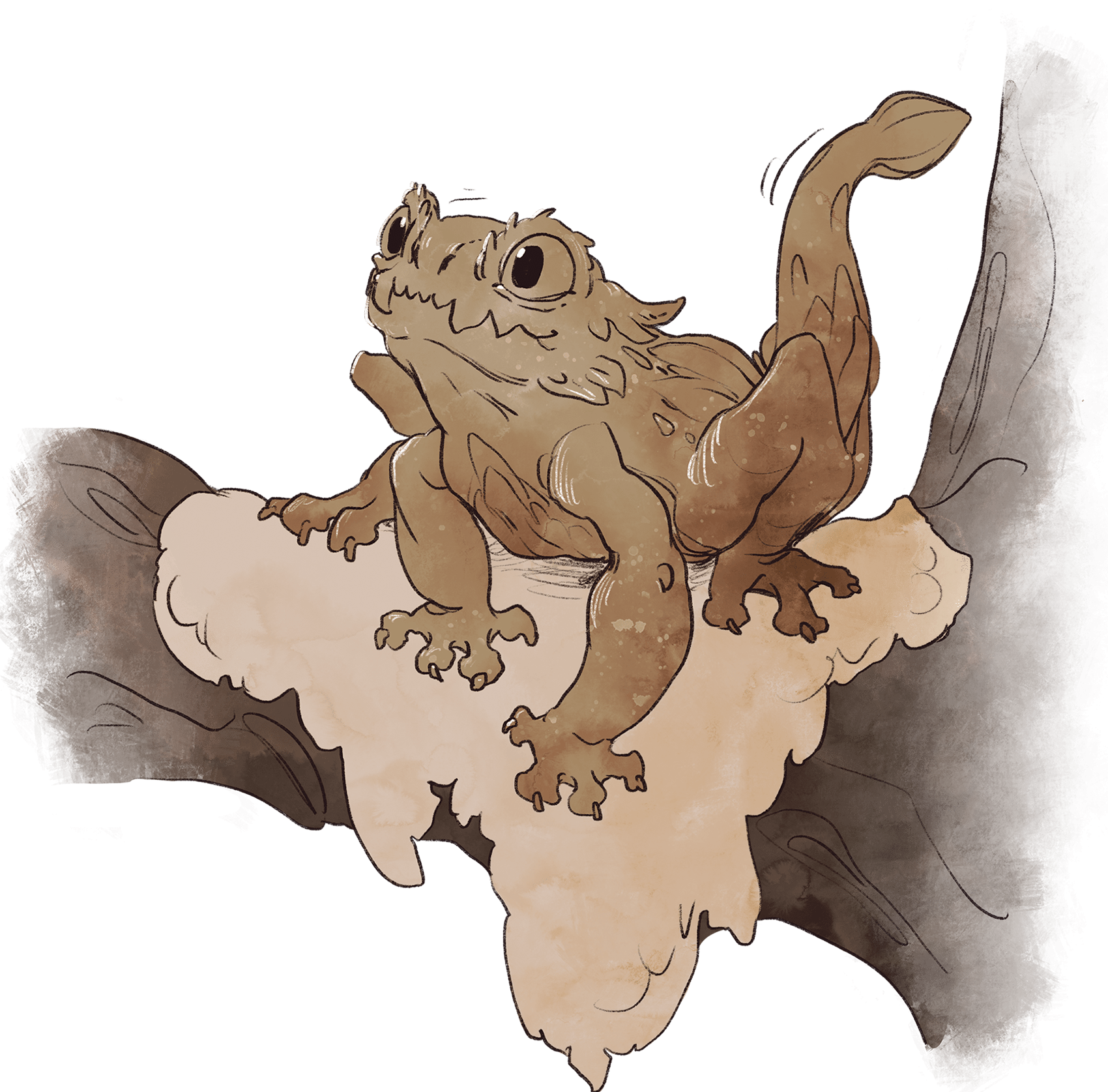
Fig. 2 A young clematis dragon at rest on a mossy perch.